We're not here to shame anyone about screen time. Screens are part of modern life, and plenty of digital content is genuinely educational. But as parents and builders, we think it's worth understanding why hands-on activities hit differently.
The research is pretty compelling.
Spatial Reasoning
When a child folds a flat piece of paper into a 3D shape, they're doing something screens can't replicate: translating a 2D plan into a physical object. Studies from the University of Chicago show that children who regularly engage in spatial play — building, folding, constructing — develop stronger mathematical reasoning later in life.
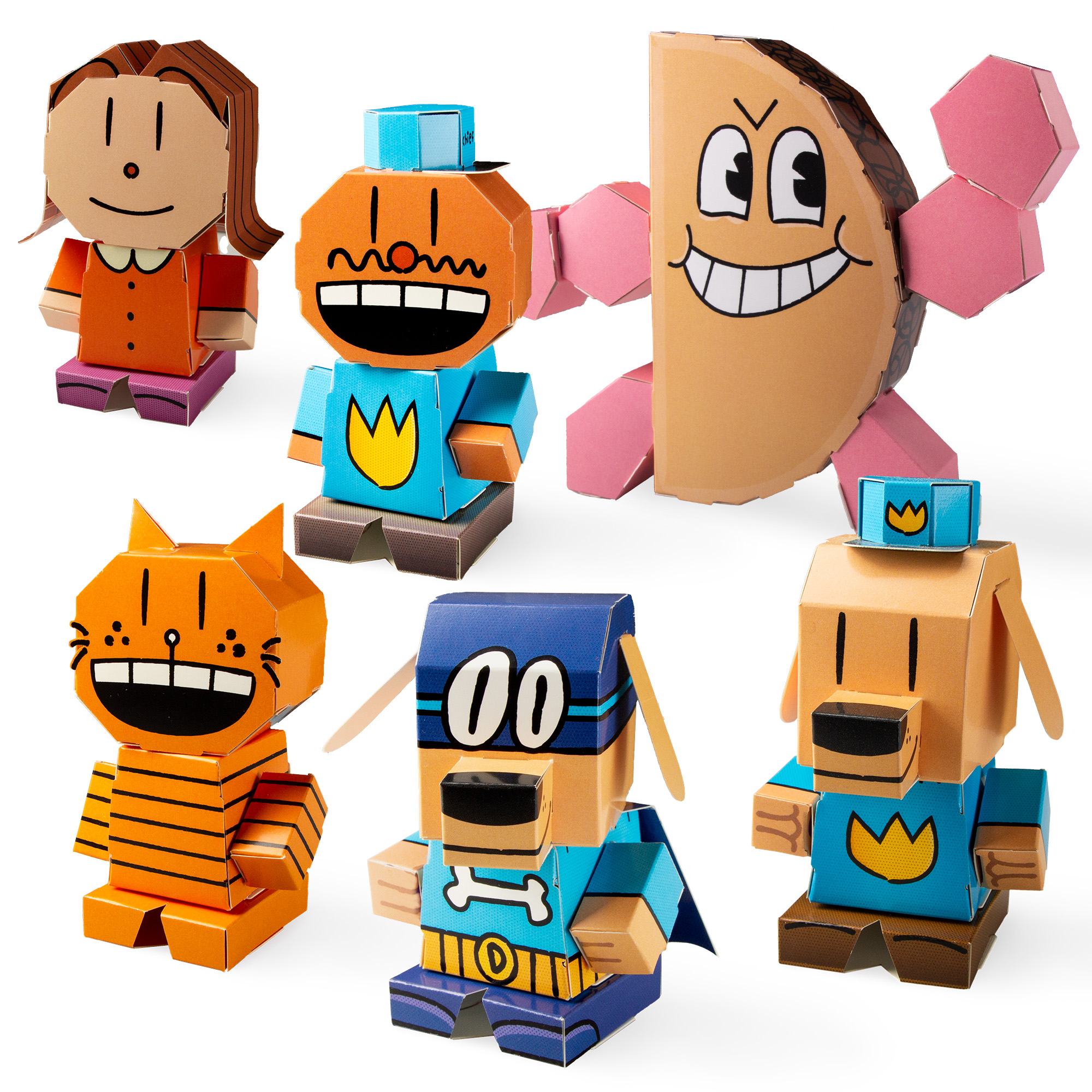
Every Cubles character starts as a flat sheet. By the time a child finishes building, they've practiced spatial visualization dozens of times without even knowing it.
Fine Motor Development
Swiping and tapping use a fraction of the hand movements that folding, pressing, and clicking require. The American Academy of Pediatrics emphasizes that fine motor skills — the small, precise hand movements used in writing, drawing, and building — need physical practice to develop properly.
Our patented key joint system requires kids to fold accordion-style and insert at precise angles. It's challenging enough to build skill, but forgiving enough that every kid succeeds.
The Flow State
You know that beautiful quiet that happens when a kid is completely absorbed in building something? Psychologists call it "flow" — a state of deep focus where time seems to disappear. It's where the best learning happens.
Flow requires just the right balance of challenge and skill. Too easy, and kids lose interest. Too hard, and they get frustrated. Building a Cubles character hits that sweet spot — especially for ages 6-10.
The Social Element
When kids build side by side, something wonderful happens. They talk. They help each other. They compare progress. They problem-solve together. This is social learning at its most organic.
That's why party packs work so well at birthday parties — every kid is doing the same activity at the same time, and the natural conversation and collaboration just flows.
It's Not Either/Or
We're not asking anyone to throw away the iPad. We're just suggesting that the afternoons spent building something with your hands? Those are the ones kids talk about at dinner. Those are the ones that build confidence, skill, and memory.
And honestly? They're pretty fun for grown-ups too.