
Black History Month is one of the most important opportunities we have as educators and parents to help children connect with the people who shaped our nation. But real connection doesn't happen through textbooks alone — it happens when history becomes something a child can hold.
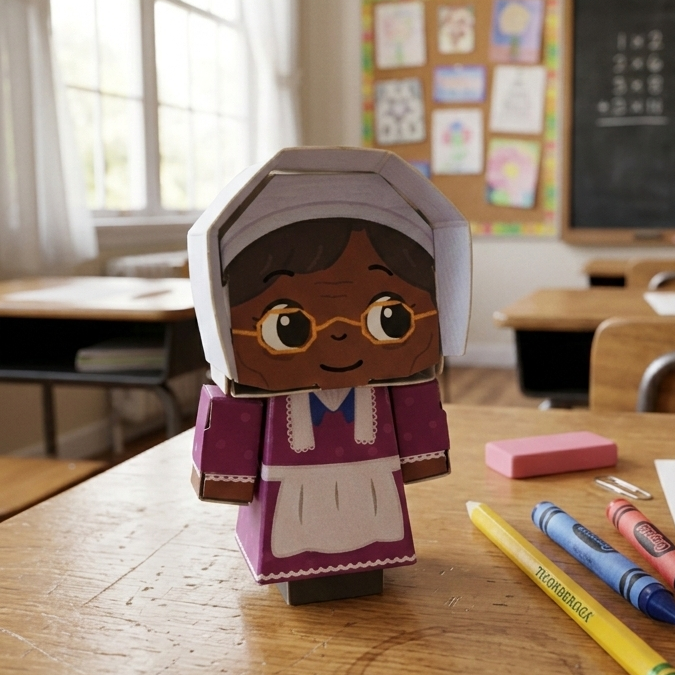
That's why we're so proud of our partnership with Thinking Nation and the Sojourner Truth classroom pack.
The Woman Who Named Herself
She was born Isabella Baumfree around 1797, in Ulster County, New York — the daughter of enslaved parents. Dutch was her first language. At just nine years old, she was sold away from her family for $100, along with a flock of sheep. She would be sold several more times, enduring years of abuse and hardship that most of us can barely imagine.
But Isabella's story isn't defined by what was done to her. It's defined by what she chose to do.
In 1826, with New York's emancipation law just a year away, she made the courageous decision to escape with her infant daughter. She found refuge with the Van Wagener family, who paid her enslaver the balance of her services so she could live free.
And then she did something extraordinary. When she learned that her five-year-old son Peter had been illegally sold into slavery in Alabama, she went to court — and won. She became one of the first Black women in American history to successfully sue a white man in a United States court and get back her child.
A Name Chosen, Not Given
In 1843, she left her old life behind entirely. She chose a new name — Sojourner Truth — because she believed God had called her to sojourn the land and speak the truth. Think about the power of that for a moment: a woman who had been given nothing, not even her own name, chose one that declared exactly who she intended to be.
And she lived up to it. For the next 40 years, she traveled the country speaking against slavery and for women's rights with a voice that could silence a room.
"Ain't I a Woman?"
Her most famous speech, delivered at the Women's Rights Convention in Akron, Ohio in 1851, cut through the arguments of her time with a clarity that still resonates today. She challenged the idea that women were too delicate for equal rights by pointing to her own life — she had plowed fields, endured lashes, and borne children who were sold away from her.
"And ain't I a woman?"
In a few powerful minutes, she exposed how Black women were excluded from the very definition of womanhood that others used to justify inequality. It remains one of the most important speeches in American history.
A Life of Firsts
Sojourner Truth's accomplishments extend far beyond that single speech:
- She helped integrate streetcars in Washington, D.C. during the Civil War by riding segregated cars in protest
- She was received at the White House by President Abraham Lincoln in 1864
- She worked with the National Freedmen's Relief Association to counsel formerly enslaved people on resettlement
- In 1872, she attempted to vote at a polling place in Battle Creek, Michigan — a quiet act of defiance decades before women won the right to vote
- She advocated for land grants from the federal government to help formerly enslaved people build independent lives
- In 2009, she became the first Black woman honored with a bust in the U.S. Capitol
- NASA named a Mars rover after her, and an asteroid bears her name
Why This Matters in the Classroom
When a student reads about Sojourner Truth, they learn facts. When a student builds a Sojourner Truth figure with their own hands, something deeper happens. They spend 10 minutes carefully folding and assembling — and in those quiet minutes, they're sitting with her story. They're holding her legacy, literally, in their hands.
That's the power of tactile learning. It creates a physical bridge between a child today and a woman who lived nearly 200 years ago. For young students especially, that bridge is what transforms information into understanding — and understanding into empathy.
Our Partnership with Thinking Nation
Thinking Nation is a 501(c)(3) nonprofit transforming social studies education. They empower students to think like historians through inquiry-based curriculum, digital tools, and professional development for educators.
Together, we created classroom packs that bring historical figures off the page and into students' hands. Each pack includes 25 buildable characters — one for every student. No scissors, no glue, no mess. Just hands-on learning that lasts.
The Sojourner Truth classroom pack is one of our most meaningful products. At $2.00 per student, it's an accessible way to bring Black History Month to life in any classroom.
Ideas for the Classroom
Here are a few ways educators are using the Sojourner Truth pack during Black History Month:
- Build and discuss: Students build the figure, then discuss her life and legacy. The building creates a natural entry point for deeper conversation.
- Speech exploration: After building, students read excerpts from "Ain't I a Woman?" and discuss what the words meant in 1851 — and what they mean today.
- The power of names: Discuss why Isabella chose the name Sojourner Truth. Have students think about what name they would choose if it had to describe their mission in life.
- Timeline activity: Place Sojourner Truth on a classroom timeline alongside other figures from the era. The physical figure on the timeline makes abstract dates feel real.
- Creative writing: Students write a letter to Sojourner Truth, or write a journal entry from her perspective. The figure on their desk keeps the connection alive as they write.
History Deserves to Be Held
We believe every child deserves to feel connected to the people who fought for the world they live in today. Sojourner Truth's story is one of resilience, courage, and an unwavering commitment to justice — a woman who chose her own name, found her own voice, and changed a nation.
That story deserves more than a paragraph in a textbook. It deserves to be built. To be held. To be carried home and placed on a shelf where a child sees it every day.
Explore our full Thinking Nation collection and bring history to life in your classroom this February.